Posts

Passion Projects: A Lesson in Scaffolding

Image
You have to walk before you run; you have to crawl before you walk; and you have to learn to swim before you can dive into the deep end. Who knew? Passion Projects are an amazing way to empower students to take ownership in their learning. When we read Inquiry Mindset over the summer, I was excited to begin this journey. After our Passion Project PD, I was hyped to jump right in! (Who doesn’t catch the hype of Jamie’s enthusiasm?) We met as a team and I had the highest of hopes for my students. It didn’t take long for the daunting reality of implementing true passion projects set in. Twenty-two different projects? Twenty-two different topics to research? Twenty-two different products created? TWENTY-TWO. My face slowly morphed into that of ¨The Scream¨ by Edvard Munch. Things that helped me: To Do List: I created a To-Do List for each of my kiddos on one document that I updated each time I met with them. Students knew when it was passion project time, th...
Image
Teachers will do their students a great service in teaching research skills... One of the greatest tools that a 1:1 classroom can implement is authentic research. Working on a research project is a challenging and rewarding experience. It is an opportunity to pursue an in-depth or deep study about any topic that interests students. The main goals are to bolster student engagement, provide an enhancement of knowledge. and at times to find solutions to some of the world's problems. Learning research skills at a young age will give students a skill that will serve them over a lifetime. This skill will not only be useful in school, but in their everyday lives as they attempt to absorb ever-increasing amounts of information. Teachers will do their students a great service in teaching research skills.   With the development of the Internet industry and web resources, researching for scientific materials is now a matter of a few clicks. Students can gather information and acqu...

Hyperdocs!

Image
Hyperdocs! One of my favorite thing about having a 1:1 classroom is being able to assign students a task and watching each individual student working at their own pace. We have incorporated hyperdocs and digital choice boards into most subjects and students are able to work as slowly or quickly as needed for their current understanding of a standard. It also allows us to offer choices and makes students excited about learning. I love seeing students who are able to take control of their learning. The hyperdocs allow us to give a variety of tasks and options so different types of learners can benefit. If anyone wants sample hyperdocs just let the 3rd grade team know. Place Value Hyperdoc  Emily, Jacobi and Chase work independently on centers.  Camdon and Kaleigh work together on a center. 

Staying Drug Free and Staying Focused

Image
This week has been Red Ribbon Week at CCES, and the students have been showing that they are and will stay drug free by participating in activities each day.  Despite the fact that our schedule and our clothing have been different from the norm, my students have done a STELLAR job of staying focused so that they can demonstrate SUCCESS on their schoolwork!  I am so proud of my 3rd Grade Superheroes!!!!!

Flexible Seating

Image
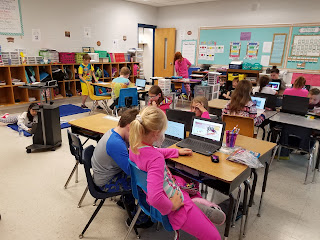
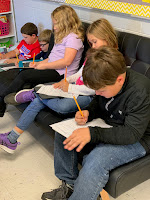
Call to Adventure       This year has been full of firsts for me: first time having a digital classroom; first time learning the basics of computer science; first time teaching digital citizenship; first time participating in Twitter chats; first time attending an EdTechTeam conference (which was also the first time I have been away from my husband overnight since we got together in 2014). From these firsts, I have grown to love the idea of adventure, taking a risk, and trying something new. I have loved stepping out of my comfort zone. Most of all, I have loved asking myself the question: If others can, why can’t I?      This exact question is what propelled me to implement Flexible Seating in my classroom. I was speaking to an inspiring first grade teacher who has successfully used flexible seating in her classroom. The “dreamer-alert,” as we call it in my house, went off in my brain. If first graders can do it, why can’t my third graders? ...
Image
The Great Cardboard Challenge What is the Cardboard Challenge? Launched from the overwhelming global response to the short film, "Caine's Arcade," the Imagination Foundation was founded to find, foster and fund creativity and entrepreneurship in children around the world to raise a new generation of innovators and problem solvers who have the tools they need to build the world they imagine. The WHY. Creativity is the most important skill of the future, and the Cardboard Challenge is a powerful tool to foster it through playful learning. The Cardboard Challenge brings the world together around the value of creativity. It’s a worldwide celebration of the genius of every child and the simple things adults can do to foster it. Our Challenge Design a solution for any weather related hazard. Create a model of your solution using cardboard and duct tape. Claire is deciding how best to use her cardboard.  Ella creates a "double wal...

Challenge Accepted!

Image
Watch the video, "Piper." Pay close attention to the role of the mother in the short film! Imagine: What if the mother continued to feed Piper? What if the mother helped Piper catch food? Problem-Solving is a skill that our students need to learn and practice. Productive struggle is OKAY! Getting stuck is OKAY! Feeling uncomfortable is OKAY! Taking risks and failing is OKAY! Struggle, discomfort, risk-taking, failing--these should be valued norms in our school!